


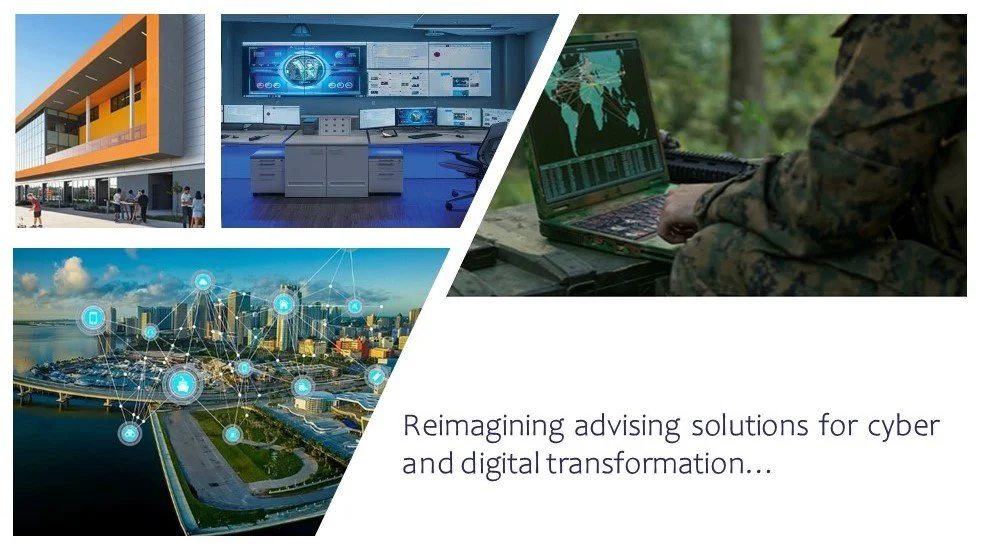
Provide cybersecurity solutions for strategy, policy, operations (including incident response), threat intelligence analysis and assessment, workforce development & training, and public-private partnerships.
Assist with vulnerability assessment and risk management planning for state, city, county, and tribal (urban and rural entities) - focusing on critical infrastructure sectors.
CIP LLC envisions the design of next generational “resell” Cyber SOC Services that can partner with companies who are looking to build a cyber portfolio and can benefit from a CISO as a Service with clients that are small to medium sized organizations.
CIP LLC is seeking Task Order development leads that can support U.S. government cyber and digital transformation opportunities. CIP LLC is in the process of obtaining CMMC certification.
CIP is seeking an investment of $1.2 million for “Cyber Training for Education” product. The PITCH DECK and more details can be shared upon request at: jeff@cipsolutions.org
** Partners like ELB Learning Solutions are identified and committed for this project that requires $50,000 for initial product demo design
Scroll below and explore past work performed to learn more about CIP LLC and services that can be offered.
CIP LLC also appreciates and please contact the email above for opportunities to speak on panels or represent at other conferences and events to talk about topics across the digital domain.

CIP LLC presents and talks about cyber threats in Europe and the successes, challenges, and opportunities for a renewed transatlantic partnership.
-
Click here for full recap and videos of Summit.
The intent of the Summit was to provide a comparative review of shifts or differences from the initial “Peace through Strength” foundations of the cyber strategy and policy published in 2018 under the Administration of President Donald J. Trump. Prior to 2018, a cyber strategy had not been written since 2003.
The Summit hosted a series of keynote speakers and panels to include Ohio Secretary of State, Frank LaRose and an update and review of recommendations and findings from the Auburn University McCrary Institute for Cyber and Critical Infrastructure Security Presidential Transition Task Force.
-
Click here for full article, “As CCP Cybersabotage Escalates, US Changes Posture”
U.S. cyber officials indicate cyber adversaries will no longer be allowed to ‘walk all over’ the United States.

CIP LLC President and CEO in collaboration with The Gold Institute for International Strategy hosted the Cyber Experts Roundtable in November 2025. Included guests from the White House, Head of Texas Cyber Command, former Executive Director of the Solarium Commission and other public and private sector like Google Mandiant. The Roundtable launched the Blueprint for a National Cyber Strategy, which CIP LLC is a Corporate Sponsor and co-author.
Click on image above for more details.

Defense Planning in focus…
In November 2022, Lieutenant General Zsolt Sándor, Deputy Commander of the Hungarian Defence Forces (HDF) received an American delegation from the Institute for Security Governance.
Delegation included CIP President and CEO with advising that underscored the efficiency and significance of sharing professional experiences in the field of cyber defense and support to the HDF Cyber Operations Command.
Source: Hungarian Defense News
CIP LLC continues to provide 1099 training instruction for the Defense Security Cooperation University, most recently to support the Foreign Partner P179989 Developing Cyber Organizations and Workforces course in June 2025.

Reimagining Cyber and Digital Transformation…
-

Consulting Service
CIP uses cyber resilient advising solutions and change management tools like those needed for workforce development, governance, and structure along with introduction of new business products that map to capability needs and requirements, such as the creation of an integrated enterprise monitoring dashboard and risk management plan.
Click here to learn how CIP could assist in developing an initial “Plan and Assess” seminar for your organization.
“As digital transformation and hyper-convergence create unintended gateways to risks, vulnerabilities, attacks, and failures, a cyber resiliency strategy quickly becomes necessary for your organization. A cyber resiliency strategy helps your organization reduce risks, financial impact, and reputational damages.”
Source: Cost of a Data Breach Report 2022 by Ponemon Institute and IBM Security.
-

CIP Business Model
Leveraging CIPs original 6-Point Plan designed in 2017, a short-term goal of CIP is to redesign a Four-Factor Advising (advise4) solution that includes initial risk management review & vulnerability assessment (based on NIST SP guidance and future Cybersecurity Framework 2.0 along with the NICE Framework for cyber workforce development. CIP uses training workshops and seminars to exercise gaps across people, process, and technology, and provide follow-on evaluation and benchmarking.
Source for Cyber Resilience Cycle: Panda Security report, presented at #PASS2018, defines cyber resilience as “the key to business security.”
The CIP business model continuously adopts to new trends, emerging technologies, and practices like the DHS CISA Zero Trust Maturity Model 2.0 and critical infrastructure operational technologies, such as use of North American Reliability Corporation (NERC) CIP standards.
Deliverables could include:
New strategy or governance document development such as cyber resiliency, threat intelligence program build, or third-party risk management plan (e.g.), critical infrastructure sectors with large supply chain and high quantity of “outside” vendors
Facilitation for replacement of legacy tools, systems (networks), applications or introduction of new technologies like CTI analysis, reporting, and information sharing capabilities.
Workforce development strategies, career path plans, and training platforms, starting with K-12 and CTE.
-

Advising Approach
Developmental “human centered” advising service framework that incorporates use of site visits and interviews, table-top exercises, and adversary cyber activity rehearsals. This includes full-cycle cyber threat intelligence analysis, information sharing & fusion, and integrated operations.
According to ISO 9241-210:2010(E) “human-centered design is an approach to interactive systems that aims to make systems usable and useful by focusing on the users, their needs and requirements, and by applying human factors/ergonomics, and usability knowledge and techniques.
The University of Oxford Cybersecurity Capacity Maturity Model for Nations is an ideal framework for this advising approach, consisting of five dimensions:
Developing cybersecurity policy and strategy;
Encouraging responsible cybersecurity culture within society;
Building cybersecurity knowledge and capabilities;
Creating effective legal and regulatory frameworks; and
Controlling risks through standards and technologies.